Sunday, August 19, 2012

Yesterday my folks, my aunt, and I went to Lexington, our nearest larger city for lunch and some shopping.  As we were driving, we passed a few farms with nice looking tobacco crops. Sad thing was, even I could remember the day when the entire countryside on that end of town was tobacco. My family has a long history in tobacco, my grandparents were tobacco sharecroppers as were the past generations of my mom's family. Sharecropping means they rented land and raised the crop allotted to the acreage. They received a portion of the money after the tobacco was sold and so did the land owner.

While I was growing up I remember my mom and my aunt both going 'home' to help my grandparents set their tobacco crop.  Small tobacco  plants were plucked from the loose soil of the tobacco bed and set using a tractor and setting attachment.

None of the people pictured in this blog are my family.
As a kid growing up we had two jobs.  One was to help 'pull plants' from the bed so that the setters could set.  The other was to follow behind the setter and fix any plants that were accidentally placed in the ground upside down. It was looooong tedious work. My mom and aunt always speak wistfully of setting time now.  Setting was a time for socialization (which might have been the reason for all the upside down plants). 

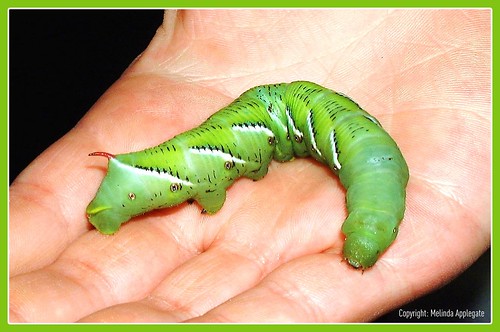
For the rest of the spring and a good part of the summer, the crop takes care of itself.  It needs weeding, watering if it doesn't rain and once it gets up a bit then you have to pluck the tobacco worms off: 


By late summer the crop is taller than most people and begins to flower:
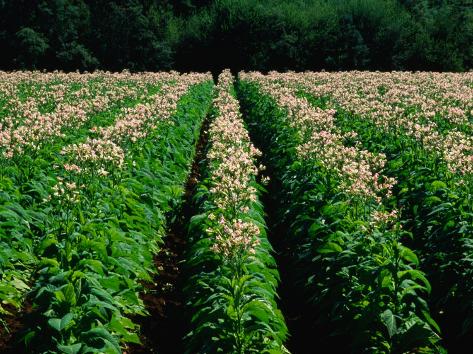
The flowers are broken off , called 'topping' the tobacco, so that the plants resources can focus on growing larger leaves. Once the leaves begin turning yellow its time to start cutting.
This isn't a very good looking crop.


Cutting. 
My dad would sometimes come help during cutting  and housing as would the other men of the family.  This was the time when my granny would cook holiday size meals to feed the work hands. My mom and aunt would help then too.  Keep in mind that cutting and housing usually coincided with canning season...I hate breaking beans and shucking corn to this day...but dang I sure miss those home canned foods!
Housing.
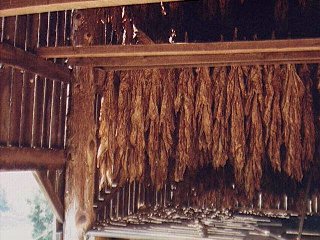
Once in the barn, the tobacco hangs suspended for a couple of months to cure.  Some places smoke cure tobacco, but not here in central Kentucky.


After the tobacco cures then comes 'into case', a mysterious state I never fully understood but it has something to do w/ the amount of moisture in the leaves, its ready to be stripped from the stalks.  Once again this was a family endeavor. 


Take a look at the mans fingers in the picture below:

Notice the blackened fingers?  I remember everyone's hands being black as tar and sticky when they came out of the stripping room.  The kids hauled the stalks out as we couldn't be trusted to pull the right leaves or the right way. Different leaves had different names (again, that knowledge is lost to me) and were different grades. That black junk didn't just end up on hands, by the end of the day the inside of your nose would be black and your boogers would be rock hard and black as coal.  Yes, a little graphic but its the truth.

From the stripping room, the tobacco is bound into bales and hauled off to sell:

After that, its bought by various companies and made into cigarettes. Most burley tobacco from Kentucky does not become cigars, a different type of tobacco is needed for that.  Most of the country looks upon those big cigarette companies with hate and disgust in their eyes...the new devils that must be driven out.  And don't get me wrong, I don't like smoking, its a habit I am thankful I never picked up, I saw the devastation it can cause in my own family. But because I have roots in tobacco, I see a different side to it.  I know that the crop was supported thousands of Kentucky families, put food on their tables and clothes on their backs.  As tobacco has become an 'evil' crop most families have sold off the family farms, the land here isn't good for raising much else. So now the countryside that used to look like this:

Looks like this:


Saturday, August 4, 2012

Yes, I realize that its been a coon's age since I posted last.  Either there hasn't been anything interesting to blog about or the events are too dang depressing to keep rehashing. Anyhoo, today I joined another member of my Meetup group and went to Mammoth Cave National Park for a cave tour. (Meetup, for those of you who are unfamiliar with the site, is http://meetup.com . People around the world start interest groups there. Plug in your zip code and away you go!)

One of the best things about the Bluegrass state is the variety of available outdoor activities and areas.  We are home to two National Parks and several National Recreations and Historic areas as well.
  
Mammoth Cave has almost 400 hundred miles of explored cave passages, making it the longest cave system in the world.  My tour today? Half a mile.  Sad, I know, but that half mile tour took 2 hours.  Over 500 wonderful knee wrecking steps. Today I took the New Entrance Tour, and it was nice.  Not my favorite, and I've taken most of the tours there.  I draw the line at the Wild Cave tours that have me crawling through cave streams on my belly.  This chick is 'corn fed' as my Papaw used to say.  He meant it as a compliment.  I mean I'm a chunky girl.  The Violet City Lantern tour is tied with the Grand Avenue tour as my favorite.  The VCL is an amazing journey into the history of the cave while using old timey lanterns as the sole light source.  One of the highlights of that section is the stone huts used back in the late 19th century as tuberculosis wards.  Some cutting edge physician from Louisville waaaaay back in the day thought that the constant climate in the cave would be perfect for people suffering from TB.  No, no one was cured but I wonder how many came away with mental issues from sunlight deprivation?  The Grand Avenue Tour is not for the 'faint of heart' meaning, if you don't like to hike, stay topside. At four miles long, its the longest tour offered and allows you to see the most of the cave, though you don't get to see the touristy stops you do on other tours.  You also spend nearly five hours below ground and if you have a mature tour group (aka people who aren't loud and obnoxious) you really start to notice the absence of things...animal/insect sounds, the sound of the wind of the trees, and the sounds of civilization. After five hours being thrust back into the light and sounds of topside you really notice it at first.

But I digress.  You might have wondered why they called the tour today 'The New Entrance Tour'.  Well, obviously its the new entrance.  The man who supposedly discovered the cave system (I apologize for not remembering his name) was actually trespassing on some else's land so he had to find a new way in.  He found a sink hole, loaded in some dynamite and BOOM!  We have a new entrance.  Apparently cave tours were a profitable business back in the 1800's and rival owners went to great lengths to draw tourists in, resulting in the Kentucky Cave Wars.  http://en.wikipedia.org/wiki/Mammoth_Cave_National_Park#Early_20th_century:_The_Kentucky_Cave_Wars

And no, this is no where close to Hatfield/McCoy territory...that's the far eastern mountain area of the state. So without further ado, here are some photo's I snapped during my forced march through the cave (Our Park Ranger didn't believe in photo opts apparently and got crabby when gaps kept forming in our lines. Dude!  We just want to look at the pretty rocks!):
Mammoth Cave is considered a 'dry cave'. Formed as the local water table dropped in elevation, there are very few stalactite/stalagmite formations that most people think of when they think 'cave'.  Instead it has immense open rooms. But there are places in the cave system where the surface sandstone (the cave is entirely limestone) has cracked and water seeps vertically causing beautiful formations:
At the bottom of the Drapery Room


Sadly we saw no bats, and just like the bears in the Great Smoky Mountains National Park, in my many visits, I've never seen any. Ranger Drill Sergeant said that according to the park biologists, there are 8,000 bats living in over 400 miles of tunnels...so its odd to actually see them in the cave and generally when the bats move into a tour area, the tour gets shut down until they move their sleeping grounds. We did see some wild life in the cave though:

That's a cave cricket if you are wondering.  First time I've ever seen one in a cave, we had them living in our garage when I lived in Southern Indiana.  I'm not a squeamish girl, but let me tell you, these MF's are CREEPY!  Their legs are 2+ inches and they are HUGE!  I soooo wanted to squash this one, but I figured Ranger Drill Sergeant would not be amused.  

Someday I hope to visit the majority of our National Parks, especially those west of the Mississippi.     What National Parks have you visited?  Are you lucky enough to live close to these areas or do you have to travel a great distance? http://www.nps.gov/findapark/index.htm